

Finding the right tools for your business makes it far easier to stay competitive on a budget.
A recent survey of 1,200 manufacturers by Parsec Automation found that 72% of organizations in this sector are using artificial intelligence in one form or another.
However, manufacturers don’t need a multimillion-dollar budget or a team of AI engineers to take advantage of AI. In fact, some of the most useful AI solutions for manufacturing aren’t tools you’ll find on the shop floor; instead, they’re AI agents that automate certain tasks and free up employees to focus on work that creates more value. An AI agent is a program that completes a specific, repeatable task, such as answering a pricing question or processing an invoice, without a person walking it through each step.
We spoke with John Fazzio, President and COO of Pilot Precision Products, a tooling manufacturer that has been using AI agents for several years, to see how AI use looks in the real world. Pilot Precision uses this technology to solve everyday operational bottlenecks, resulting in faster customer service and a measurable return on investment without replacing the people who make the business successful.
This article examines some AI applications that deliver real results for manufacturers and shares lessons from Pilot Precision that any small or medium-sized manufacturer can apply, regardless of budget or technical expertise.
Key Takeaways
What Does AI Adoption in Manufacturing Look Like?
AI adoption in manufacturing usually starts small: automating a single repetitive task, like customer inquiries or invoice processing, rather than deploying robots or company-wide platforms. There isn’t one universal answer, because it depends on the challenges your business is trying to solve.
Many people hear “AI in manufacturing” and immediately think of automated robots or advanced quality inspection systems, and while those technologies have their place, they could be out of reach for small and mid-sized manufacturers because of their cost and complexity.
The good news, however, is that some of the best AI solutions for manufacturing are much simpler. They don’t help the manufacturing process, but they automate manual work to make the business easier to run.
For example, manufacturers can use AI in the following ways:
| Business challenge | Practical AI application | Potential benefit |
|---|---|---|
| Repetitive customer inquiries | AI customer service agents | Faster responses and reduced call volume |
| Time-consuming sales administration | AI sales assistants | More time for prospecting and relationship building |
| Manual accounting tasks | AI workflow automation | Faster processing with fewer errors |
| Inventory and pricing requests | AI connected to ERP systems | Up-to-date information for customers and distributors |
| Order processing | Intelligent document processing | Faster order entry and better accuracy |
Where Should Manufacturers Start With AI?
 On the flip side, the most successful AI projects often begin by identifying a time-consuming task that employees perform dozens or even hundreds of times each week and looking for a way to lessen its burden. These jobs are often rule-based and don’t require complex decision-making, so they’re ideal for AI agents.
John Fazzio took this approach when his company first got involved with AI. Instead of trying to automate an entire department, Pilot Precision focused on customer service calls from distributors requesting pricing and inventory availability, which was a bottleneck within the company.
These calls were necessary, but they took up hours of the customer service team’s day and forced them to answer the same questions over and over again.
Pilot Precision didn’t want to replace the entire customer service team, though, so they built an AI agent that connects directly to the company’s ERP system. The agent, which is a chatbot on the company’s website, can:
- Verify the customer
- Retrieve customer-specific pricing
- Check live inventory levels
- Answer routine pricing and availability requests
If the request falls outside the agent’s capabilities or something doesn’t look right, the conversation is handed off to a team member for review.
“My preference is that AI agents shouldn’t be asked to think too much,” notes Fazzio. “You want to give them specific tasks. ‘This is what I need you to do,’ and then just have them do it over and over and over.”
The results came quickly for Pilot Precision, too, as within a few months, the AI agent was handling approximately 40 to 50 customer inquiries each day, allowing the customer service team to spend more time helping customers solve complex problems.
According to Fazzio, “the ROI for that agent was recouped in less than two months,” while costing only fractions of a cent per interaction to operate.
How Can AI Help Manufacturing Sales Teams?
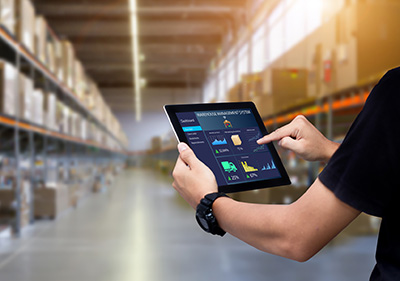 Automation is often the first thing that comes to mind when thinking of AI for industrial distributors and manufacturers, but one of its biggest benefits is helping sales teams become more productive.
According to Salesforce, sales representatives spend 70% of their time handling administrative work instead of selling. They could spend hours looking up product information and checking inventory, giving them less time to build relationships with distributors and end users.
AI can eliminate many of these recurring activities for the sales team. For example, these tools can look up product information and retrieve pricing and inventory data in an instant, so employees don’t have to do it.
This technology also provides an advantage for manufacturers that rely on distributors. When distributors can quickly access inventory and product information, they’ll find it easier to serve their own customers. This is where supply chain and AI intersect: Giving distributors real-time access to the data they need keeps orders moving without extra calls or emails back to the manufacturer.
The result is better responsiveness without sacrificing the personal relationships that truly matter in manufacturing sales.
What Other Business Processes Can AI Improve?
Beyond customer service, AI can also streamline accounting workflows like accounts receivable, accounts payable, and order entry. Pilot Precision didn’t stop after customer service: The company saw so much success with its initial AI investment that it took the technology even further, starting in the accounting department.
Accounts Receivable
Every day, customers would email remittance advice to Pilot Precision after paying invoices by ACH. The problem was that an employee had to review the email, locate the invoices in the ERP system, apply the payments, and enter the information manually to process these payments.
Today, an AI agent performs most of that work without human intervention. This agent:
- Monitors the accounts receivable inbox
- Identifies payment emails
- Extracts invoice numbers and payment amounts
- Verifies the information against Pilot Precision’s ERP system
- Creates a cash receipt entry for review
The transaction is also flagged for human review if something doesn’t match.
According to Fazzio, the agent now processes roughly 93% of cash receipts without manual intervention. Pilot Precision didn’t let the employees who handled this job go, though, as the company reassigned them to more valuable work within the organization.
“We don’t want AI replacing anybody,” says Fazzio, “but what it’s really done is allowed my accountants to have more time to work on value-added exercises and not just simply adding cash receipts to the system.”
Accounts Payable
Pilot Precision applied the same philosophy to accounts payable, as the company’s newest AI agent:
- Reviews incoming invoices
- Determines whether they’re tied to purchase orders
- Performs three-way matching against purchase orders and receiving records
- Prepares invoices for approval
The agent also uses a growing knowledge base to apply the appropriate accounting rules based on previous transactions when specific invoices aren’t linked to purchase orders.
Order Entry
Pilot Precision’s next AI project focuses on order entry, which is another manual job for manufacturers. The company receives most customer purchase orders by email, and Fazzio notes that today’s AI models are capable of reading those documents and entering orders into the ERP system far more efficiently than traditional optical character recognition (OCR) systems could just a few years ago.
How Should Manufacturers Think About AI as a Business Tool?
At Durrie Sales, we help manufacturers identify opportunities to grow their business through stronger sales strategies and practical business improvements.

Frequently Asked Questions: AI in Manufacturing
Which AI tools should manufacturers consider?
The best AI tools address specific business challenges instead of trying to automate everything. AI agents and inventory management tools free up significant time for smaller manufacturers because they target one workflow instead of trying to do too much.
How can AI help manufacturing sales teams?
AI can automate recurring administrative work like retrieving pricing information and preparing quotes. This capability gives sales representatives more time to build relationships with distributors and customers.
Do small manufacturers need a large budget to adopt AI?
No. Many manufacturers begin with a single workflow that delivers value before expanding into other areas.
What should manufacturers automate first?
Manufacturers will want to find recurring, high-volume tasks that follow consistent business rules. Things like customer service inquiries and inventory lookups are strong candidates because they consume significant employee time while requiring little human judgment.